
PART 2: I bankrolled my retired Army mother-in-law with $6,000 a month,
PART 2: I bankrolled my retired Army mother-in-law with $6,000 a month, but when I finally refused her greedy $5,000 demand to fund a luxury “military charity gala” shopping spree, she grabbed a ceremonial Army baton and struck me so hard I collapsed. 002
PART 3
I pressed my palms against the hardwood floor and forced myself to breathe.
The room tilted sideways.
A ribbon of blood slipped from the corner of my mouth and struck the floor in slow, dark drops. My left eye was already swelling shut. Every heartbeat sent a fresh pulse of pain through my cheekbone.
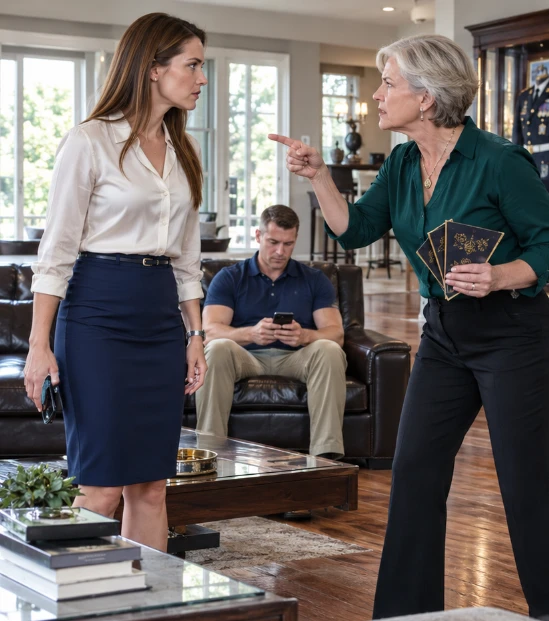
Evelyn stood over me with the ceremonial baton resting against her shoulder.
Ryan remained on the sofa.
His phone glowed in his hand.
For one irrational second, I wondered whether he was recording me.
Then I saw his thumb moving.
He was deleting something.
I lowered my head before either of them could see the realization on my face.
Evelyn gave a small, satisfied laugh.
“Now,” she said, “are you going to transfer the money?”
I touched my tongue to the inside of my cheek and tasted blood.
“No.”
Her smile disappeared.
Ryan finally looked up.
“Lisa,” he said quietly, “don’t make this worse.”
I stared at him through my one functioning eye.
His voice held no concern. No shock. No anger toward the woman who had just struck his wife hard enough to knock her to the floor.
Only warning.
That told me everything.
This wasn’t an argument that had gone too far.
This was control.
And they both believed I would surrender because I had always been the responsible one. The calm one. The person who paid the bills, protected reputations, and cleaned up disasters before anyone outside the family noticed.
They thought my silence was weakness.
They had forgotten that silence was how I worked.
I slowly pushed myself upright.
The room lurched again, but I held on to the edge of the coffee table until the dizziness passed.
“I need the bathroom,” I whispered.
Evelyn stepped closer.
“You need to open your banking app.”
“I’m bleeding.”
“You’ll live.”
Ryan looked at the growing stain on the floor.
For the first time, something like fear crossed his face.
Not fear for me.
Fear of evidence.
“Mom,” he said, “put the baton down.”
Evelyn scoffed.
“She’s being dramatic.”
Ryan stood and reached for it, but she pulled it away.
“Don’t touch me.”
Their eyes met.
Something unspoken passed between them.
That was when I understood that Ryan hadn’t expected her to hit me—not like that—but he had expected something. Intimidation. Threats. Maybe enough fear to make me transfer the money.
He had known there would be pressure.
He had chosen to sit there and let it happen.
I staggered toward the hallway.
Neither of them stopped me.
In the downstairs bathroom, I locked the door, turned on the faucet, and looked at my reflection.
The left side of my face was turning purple beneath my eye. Blood coated my lower lip and chin. A split ran along the inside of my cheek where my teeth had cut through the flesh.

I took three photographs.
Front.
Left profile.
Close-up of the swelling.
Then I opened the concealed security application on my phone.
Ryan knew about the cameras covering the entrances, driveway, and office. He did not know about the two emergency cameras I had installed after discovering that files had been moved inside my home office while I was traveling.
One camera faced the living room.
The second faced the hallway outside my office.
I accessed the live feed.
Evelyn was pacing.
Ryan had taken the baton from her and was wiping it with a gray dish towel.
My hands stopped shaking.
The camera had recorded everything.
Her demand.
My refusal.
The strike.
My fall.
Her words.
You should’ve remembered who outranks you.
And now Ryan was wiping the weapon.
I downloaded the footage to an encrypted cloud server, duplicated it to a protected client repository, and sent a preservation link to someone Ryan and Evelyn had never met.
Special Agent Marcus Bell.
Marcus worked with the Defense Criminal Investigative Service. We had crossed paths three years earlier when one of my subcontractors had attempted to sell controlled network credentials to a foreign intermediary. I had discovered the breach, preserved the logs, and turned over the evidence before the damage spread.
Marcus had once told me, “If you ever see something that smells like fraud involving defense money, don’t call the loudest person. Call the person who listens.”
I sent him six words.
I need help. Ryan is involved.
Then I called 911.
I kept my voice low.
“My mother-in-law attacked me with a metal baton. My husband witnessed it and is destroying evidence. I am injured, but I’m still inside the house.”
The dispatcher’s tone changed instantly.
“Are you able to leave safely?”
“Yes.”
“Do not confront them. Take your phone and move toward an exit.”
I ended the call, washed enough blood from my chin to see clearly, and opened the door.
Ryan was waiting in the hallway.
He had placed the baton somewhere out of sight.
His face had become gentle.
Concerned.
The expression might have convinced someone who hadn’t watched him clean my blood from a weapon thirty seconds earlier.
“Lisa,” he said, “Mom lost control.”
I walked past him.
He caught my wrist.
His grip wasn’t hard.
It didn’t need to be.
“Where are you going?”
“To the hospital.”
“We can drive you.”
“No.”
Evelyn appeared behind him.
Her posture had changed. The fury was gone, replaced by calculation.
“You fell,” she said.
I turned slowly.
“What?”
“You were angry. You tripped near the coffee table and hit your face.”
Ryan’s fingers tightened around my wrist.
“Lisa, listen to me. Mom could lose her retirement benefits over an assault charge.”
“That isn’t how retirement benefits work,” I said.
He blinked.
Even through the pain, I almost laughed.
They had spent so long treating me like a bank account that they had forgotten I understood the systems they lied about.
Evelyn crossed her arms.
“You’re going to destroy this family over a misunderstanding?”
“No,” I answered. “You did that when you picked up the baton.”
Ryan pulled me closer.
“Think carefully.”
“I am.”
“You have contracts under review. Investigations create attention. Attention creates questions. Do you really want people examining your company?”
There it was.
The threat beneath the concern.
But it contained something else.
Confidence.
He believed an investigation into my company would frighten me.
Why?
My cybersecurity firm had survived federal audits, penetration reviews, financial disclosure examinations, and security compliance inspections. I had nothing to hide.
Unless Ryan believed there was something in my records that I didn’t know about.
A cold sensation moved through me that had nothing to do with the injury.
I looked at his phone.
“What did you do?”
For the first time that night, he lost control of his expression.
Only for half a second.
But I saw it.
Before he could answer, red and blue lights swept across the front windows.
Ryan released my wrist.
Evelyn’s face went pale.
“You called the police?”
I reached for the front door.
She stepped between me and the entrance.
“You ungrateful little—”
“Move.”
“You are not bringing civilian police into my son’s house.”
“My house,” I said. “I paid for it.”
The doorbell rang.
A fist struck the door.
“Police!”
Evelyn lowered her voice.
“You open that door, and you will regret it.”
I pulled the door open.
Two Bell County sheriff’s deputies stood on the porch. Behind them, an ambulance waited at the curb, its lights washing the lawn in white and red.
The first deputy looked at my face.
His entire posture sharpened.
“Ma’am, step outside.”
I did.
Ryan followed immediately.
“Officer, there’s been a misunderstanding.”
The deputy raised one hand.
“Stay inside, sir.”
“My wife fell.”
I stopped on the porch and looked back at him.
“He wiped down the weapon.”
The second deputy moved past Ryan before he could react.
Evelyn began shouting.
“I am a retired command sergeant major! You will address me with respect!”
The first deputy guided me toward the ambulance.
“Who struck you?”
“Evelyn Hayes.”
“With what?”
“An aluminum ceremonial baton.”
“Where is it now?”
“Ryan moved it.”
Behind us, the second deputy’s voice rose.
“Sir, place your hands where I can see them.”
Ryan answered with the polished authority he used whenever he wanted civilians to remember he had once worn a uniform.
“You need to understand that I am a decorated officer.”
“Hands where I can see them.”
“I know the commanding general at Fort Cavazos.”
“Hands. Now.”
The medals in Ryan’s memory did nothing against a deputy who had seen my face.
Paramedics examined me inside the ambulance. One suspected an orbital fracture and possible concussion. They urged me to go to the emergency room immediately.
I agreed, but before they closed the doors, I saw another vehicle enter the street.
Dark sedan.
Government plates.
Marcus Bell stepped out wearing jeans, boots, and a navy jacket.
He had arrived faster than I expected.
Too fast.
He must have already been nearby.
He walked toward the deputies, displayed his credentials, and spoke quietly to them. Then he looked at me.
Not at the swelling.
Not at the blood.
At my phone.
I understood.
I unlocked it and handed it to him.
“The footage is preserved remotely,” I said.
“Good.”
“Ryan mentioned my contracts. He implied there was something an investigation would uncover.”
Marcus’s jaw tightened.
“Did he use those exact words?”
“Almost.”
“Have you reviewed your vendor payment accounts recently?”
“Every week.”
“Not your business accounts. The joint household account linked to your company reimbursement profile.”
My stomach dropped.
The doors of the ambulance remained open.
Outside, Evelyn’s voice carried from the house.
“You cannot search private military property!”
A deputy replied, “This is not military property.”
I stared at Marcus.
“How do you know about that account?”
He glanced toward Ryan.
“Because your husband’s name appeared this morning in a financial intelligence referral.”
The pain in my face seemed to vanish.
“What referral?”
“A sequence of transfers involving a veterans’ nonprofit, a defense subcontractor, and an account connected to your home address.”
“I’ve never authorized payments to a veterans’ nonprofit.”
“I know.”
The paramedic looked between us.
“She needs a hospital.”
Marcus nodded.
“I’ll meet you there.”
“What happened this morning?”
“Go get treated, Lisa.”
“Marcus.”
He lowered his voice.
“Someone has been using your company’s credentials to approve invoices connected to the Sentinel Valor Foundation.”
The name struck me immediately.
It was printed across the gala invitations Evelyn had been holding.
The luxury military charity gala.
I looked past Marcus toward my house.
Evelyn was no longer shouting.
She stood in the doorway between two deputies, completely still.
Watching us.
She knew.
The ambulance doors closed.
The CT scan confirmed a small fracture along my left orbital floor, severe bruising, and a concussion. The doctors wanted to keep me under observation.
I lay beneath fluorescent lights while a nurse cleaned the dried blood from my neck.
At 1:17 a.m., a civilian detective named Nora Delgado entered the room.
She carried a tablet and spoke with the careful patience of someone accustomed to victims changing their minds.
“Mrs. Hayes, I need to ask you about the assault.”
“My last name is Mercer professionally,” I said. “Legally, it’s still Hayes.”
“Understood.”
She showed me a still image taken from my living room recording.
Evelyn stood frozen mid-swing.
The baton was inches from my face.
“Is this authentic footage?”
“Yes.”
“Was it edited?”
“No.”
“Did you provoke or threaten Evelyn Hayes?”
“I refused to transfer five thousand dollars.”
Delgado’s mouth tightened.
“That is not provocation.”
“To Evelyn, it was insubordination.”
“Your husband claims he was in shock.”
“He wiped down the baton.”
“We have that on video too.”
“Did you find it?”
“Yes. In the garage, inside a golf bag.”
I closed my eyes.
Ryan hated golf.
He had once told me it was a ridiculous sport for men who needed witnesses to their leisure.
Now the golf bag was where he hid a weapon.
Delgado swiped to another image.
Ryan stood near the kitchen holding the gray towel.
“Your husband says he was cleaning the baton because he was afraid the blood would cause his mother to panic.”
“That may be the stupidest thing he has ever said, and I’ve heard him explain cryptocurrency.”
For the first time, Delgado smiled.
Then her expression became serious.
“Mrs. Hayes, did your husband know his mother intended to assault you?”
“I don’t know.”
“Did he ever threaten you before tonight?”
“Not directly.”
“Financially?”
I thought about the bills, the monthly transfers, the constant pressure, the sudden changes in his mood whenever I questioned his mother’s spending.
“He repeatedly told me that refusing his mother would damage his mental health. He said I owed her because the Army had taken his health and she had given the Army her entire life.”
“Did you believe that?”
“For too long.”
Delgado placed the tablet on her lap.
“Your mother-in-law claims the six-thousand-dollar monthly payments were part of a consulting agreement.”
I stared at her.
“What consulting agreement?”
“She says she advised your company on military culture and client relationships.”
“She has never worked for my company.”
“She produced documents.”
My pulse quickened.
“What documents?”
“Contracts bearing your electronic signature.”
“That signature is false.”
“We suspected you might say that.”
“It’s not a suspicion. I can prove it.”
The door opened.
Marcus entered carrying a slim black laptop bag.
He waited until the nurse left before placing the bag on the rolling table beside my bed.
“Show her,” he said.
I opened the laptop and accessed my company’s secure signing ledger through a multi-factor authentication token stored on my keychain.
Every legitimate contract generated a certificate containing timestamp data, device identification, IP address, cryptographic hash, and authentication history.
Evelyn’s supposed consulting agreement did not appear.
Delgado sent me a copy of the document.
I opened the file metadata.
Created four months earlier.
Modified seven times.
Signed from an IP address registered to my home.
Authenticated using a backup access code.
I had never used backup codes from home.
Ryan had access to the locked fireproof safe in my office.
The backup codes were inside it.
“He stole my authentication credentials,” I said.
Marcus’s expression did not change.
“Keep going.”
The contract listed Evelyn as a strategic consultant earning six thousand dollars a month. It also granted her authority to represent my company at veteran-outreach events.
The final page contained an expense provision.
Gala attire.
Travel.
Private donor receptions.
Luxury accommodation when required for senior military engagement.
The five thousand dollars had never been about a dress.
It was about creating a matching financial trail.
If I transferred the money, they could classify it as an authorized business expense under the forged agreement.
“Why?” I asked. “Why would they need my money if they already had access to the account?”
Marcus pulled a chair closer.
“Because the account access triggered compliance alerts. Personal transfers made directly by you looked legitimate.”
“The six thousand dollars every month.”
He nodded.
“They weren’t only taking your money. They were using your payments to support the appearance of an employment relationship.”
I felt suddenly cold.
“How much?”
“We don’t know yet.”
“Marcus.”
“We’ve identified at least eight hundred and forty thousand dollars moving through entities connected to Sentinel Valor.”
Delgado studied me.
“Your company appears to be one of several businesses whose identities were used.”
I looked at the forged contract again.
Ryan had watched me work until two in the morning. He had brought me coffee during audits. He had listened while I explained authentication safeguards, invoice procedures, and regulatory controls.
I had mistaken his attention for support.
He had been studying me.
A knock sounded at the door.
A hospital security officer stepped inside.
“Detective, there’s a man outside insisting he’s the patient’s husband.”
Delgado stood.
“Do not let him in.”
“He says he has power of attorney.”
I sat upright too quickly, and pain burst behind my eye.
“What?”
Marcus caught my shoulder.
“Easy.”
“I never gave Ryan power of attorney.”
The guard held out a document.
Delgado took it.
The signature at the bottom looked like mine.
It was almost perfect.
Almost.
Marcus read over her shoulder.
“This was notarized eleven months ago.”
“By whom?” I asked.
Delgado’s eyes moved to the bottom of the page.
Then she looked at Marcus.
“Evelyn Hayes.”
Of course.
Retired command sergeant major.
Veterans’ organization leader.
Notary public.
The document granted Ryan authority over my personal accounts, medical decisions, business operations, and digital assets if I was “temporarily incapacitated.”
A concussion could qualify.
An orbital fracture.
Medication.
Hospital observation.
Ryan had not come to see whether I was alive.
He had come to activate the document.
“What can he do with this?” I asked.
Marcus answered first.
“Nothing, once the fraud is established.”
“How long does that take?”
Silence.
That was the answer.
I reached for my phone.
The screen displayed seventeen missed calls from Ryan, nine from Evelyn, and three from my company’s chief financial officer, Angela.
A new email appeared.
Emergency Administrative Action Completed
I opened it.
My access to the company’s primary systems had been suspended.
The request had been submitted by Ryan Hayes under authority of a notarized durable power of attorney, citing my medical incapacity and concerns about compromised judgment following a domestic incident.
I turned the screen toward Marcus.
“They planned this.”
Delgado read the email.
“They couldn’t have planned the injury.”
“Maybe not the exact injury,” I said. “But they planned to declare me unstable or incapacitated.”
The five-thousand-dollar demand had been a trap.
If I paid, they strengthened the forged consulting arrangement.
If I refused and lost my temper, they could portray me as irrational.
If Evelyn provoked me into striking first, they could claim self-defense.
And if violence left me injured or hospitalized, Ryan had the power-of-attorney document ready.
Every path ended with them gaining control.
But Evelyn had made one mistake.
She had hit me in view of a hidden camera.
My phone rang.
Angela.
I answered.
“Lisa?”
Her voice shook.
“I’m here.”
“Oh, thank God. Ryan called me and said you suffered a psychiatric episode. He told me you attacked his mother.”
“I have video proving otherwise.”
There was a pause.
Then Angela whispered, “There’s more.”
“What?”
“Someone initiated a transfer from the reserve operating account.”
“How much?”
“All of it.”
The room narrowed.
My reserve account held nearly three million dollars—payroll protection, tax obligations, emergency liquidity, and restricted client funds.
“Did it clear?”
“No. I blocked it, but Ryan submitted authorization under the power of attorney. The bank’s legal department froze the account pending review.”
“Where was the money going?”
Angela hesitated.
“Sentinel Valor Foundation.”
Marcus heard her through the speaker.
“Ask for the destination bank and routing records,” he said.
Angela recognized his voice as authority and immediately agreed.
Then she added, “Lisa, someone also sent an email to our largest defense client claiming we suffered a major data breach.”
My stomach turned.
“That’s false.”
“I know. But the email included confidential architecture diagrams.”
Only six people had access to those diagrams.
I was one.
Angela was another.
Ryan was not.
Unless he had entered my office.
The second hidden camera.
I opened the cloud archive and searched the hallway footage.
There.
2:43 a.m., five nights earlier.
Ryan approached my office carrying a military duffel bag.
He unlocked the door using a key.
I had never given him one.
He remained inside for forty-seven minutes.
When he left, the bag appeared heavier.
I forwarded the video to Marcus.
He watched it once.
Then again.
“Do you recognize the duffel?”
“Yes. He keeps it in the storage room.”
Marcus called someone and gave a sequence of clipped instructions.
Search warrant.
Electronic devices.
Storage room.
Immediate preservation.
When he ended the call, I asked, “Will the sheriff execute it?”
“They already have probable cause related to the assault and evidence destruction.”
“What about Fort Cavazos?”
His eyes settled on me.
“Ryan didn’t only store things at the house.”
The way he said it made the room feel smaller.
“What did he store on base?”
“We believe he maintained access to a reserve-unit office using credentials that should have been deactivated after his discharge.”
“Believe?”
“We confirmed entry logs an hour ago.”
I looked at the clock.
2:36 a.m.
This had become far larger than a domestic assault.
Delgado’s phone rang.
She listened, asked two questions, and ended the call.
“They found the duffel,” she said.
“What was inside?” I asked.
“Two laptops, six external drives, blank nonprofit checks, donor records, and copies of identification documents.”
Marcus added, “They also found three military common access cards belonging to other people.”
“That’s impossible,” I said. “Those should have been reported and disabled.”
“They were disabled.”
“Then why keep them?”
“Because the certificates may still be useful for impersonation attempts, depending on what systems were misconfigured.”
I pressed my fingers to my forehead.
Ryan had spent months telling me he was depressed because civilian life had stripped him of purpose.
I paid for therapy.
Career coaching.
Certification courses.
A new truck because he said he needed one thing that made him feel capable again.
All while he and his mother built a fraud scheme beneath my roof.
At 3:08 a.m., the hospital administrator arrived with legal counsel. Ryan was escorted from the property after attempting to use the forged power of attorney to demand access to my room and medical records.
He was not arrested.
Not yet.
That worried me more than handcuffs would have.
Marcus explained that investigators sometimes delayed arrests to watch suspects communicate, move evidence, or alert accomplices.
“So you let him leave?”
“We know where he is.”
“And Evelyn?”
“Assault charges are being processed. She may be released pending formal arraignment because of her age, record, and local ties.”
“She struck me with a metal baton.”
“The video makes the case strong.”
“That wasn’t my question.”
Marcus leaned back.
“You’re angry.”
“No. I’m finished being surprised.”
At 3:41 a.m., my company’s outside counsel obtained an emergency injunction preventing Ryan from exercising the power of attorney. The bank froze every related transfer. My access was restored under enhanced controls.
At 4:05 a.m., Angela discovered that the false breach notification had been scheduled three days earlier.
Proof that the entire event had been planned before Evelyn demanded the money.
At 4:26 a.m., investigators confirmed that Sentinel Valor Foundation had collected millions in donations by claiming to provide housing, trauma treatment, and emergency assistance to wounded veterans.
Most of the money had never reached them.
It funded private travel, vehicles, jewelry, gala events, and consulting payments to shell companies.
Evelyn sat on the foundation’s advisory board.
Ryan served as an unnamed technology coordinator through an intermediary firm.
And my company’s reputation had been used to assure donors that Sentinel Valor’s systems were secure.
My name had been their shield.
At 5:02 a.m., Marcus received a message.
He read it without speaking.
“What is it?” I asked.
“Military Police have entered the reserve office.”
Despite the medication, I swung my legs over the side of the bed.
“What did they find?”
“We don’t know yet.”
“You know something.”
He looked toward the pale light beginning to form beyond the hospital window.
“They found a locked communications case.”
“That could contain anything.”
“It has your company logo on it.”
“I never supplied equipment to Ryan’s unit.”
“I know.”
At 5:18 a.m., a convoy turned onto our street.
Military Police.
Civilian detectives.
A digital forensics vehicle.
Federal agents.
Neighbors stepped onto porches as dawn began lifting the darkness.
The officers carried warrants, seizure orders, and financial restraint documents.
The storm I had unleashed had reached the front door.
But I was still in a hospital bed when my home security application sent an automatic alert.
Interior motion detected: office camera.
That made no sense.
The house was under law-enforcement control.
I opened the feed.
A figure stood inside my office wearing gloves and a dark jacket.
Not Ryan.
Not Evelyn.
Not any investigator I recognized.
The person moved directly toward the hidden camera.
No searching.
No hesitation.
They knew exactly where it was.
Before the feed went black, the figure looked up.
For less than a second, I saw the face clearly.
My breath stopped.
Marcus noticed.
“Lisa?”
I replayed the final frame.
The person inside my office was Colonel Daniel Mercer.
My father.
The man who had supposedly died in Afghanistan twelve years earlier.
And in his hand was a classified storage device I had seen only once before—inside the evidence photograph from the investigation that had built my entire career.
My father looked directly into the camera.
Then he smiled.
